Timing of massage before an event varies based on your reasons for getting the massage.
If muscle soreness and tension from a big training block are your main concern, then it is probably best to schedule a massage at least 3 days out from the event.
This lets your therapist work more deeply while still allowing you to recover from any post massage soreness or fatigue that may follow. It also allows your body to adapt to the slight movement changes that come from loosening up contracted tissue.
If your goal is to relax before the event because it helps with mental preparation, then massage the day before is fine but keep it fairly light.
Massage can also be used as part of a warm-up routine directly before the start of competition (i.e. within about an hour of start time). This is a faster and lighter style of massage that helps wake the muscles up and should be followed by an appropriate dynamic warm-up.
Sometimes things do go wrong in the days leading up to an event and this can mean a visit to your massage therapist the day before for an emergency treatment just to get you to the start line (and fingers crossed from there!)
In this case we would need to weigh up the benefits of a deeper/stronger massage treatment with any possible negative effects on performance.
Please note: This post contains affiliate links. If you click on any links in this post, or use the discount code provided, I will earn a commission.
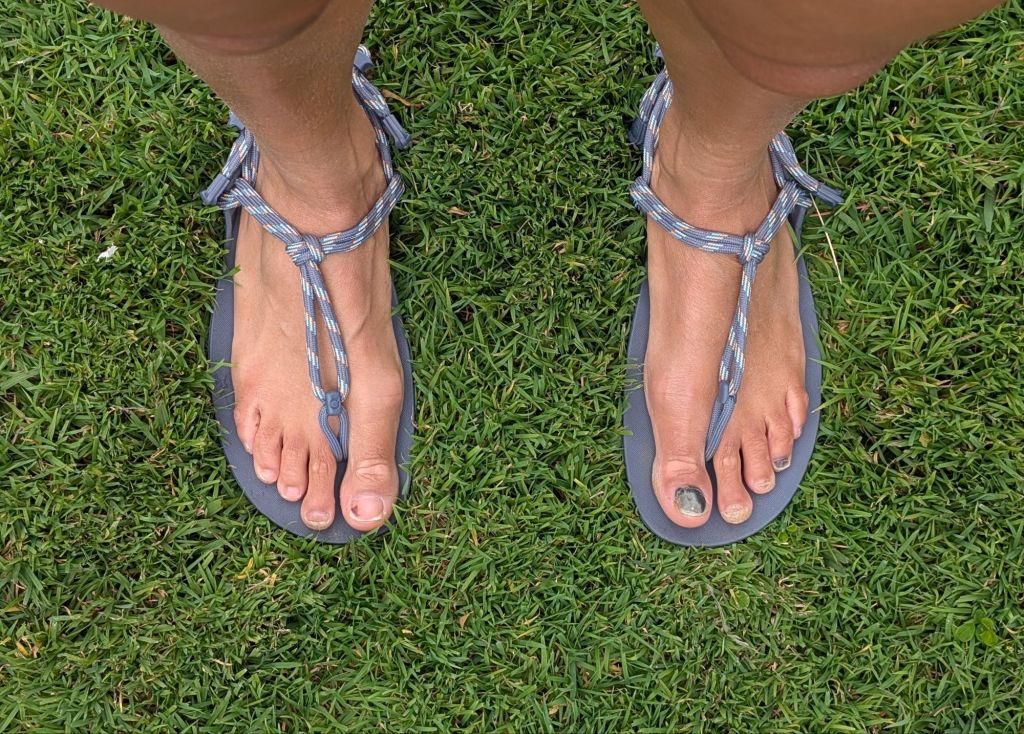
I am now into my 2nd week of training with barefoot sandals. I had one week of no running directly following the marathon where I did a couple of short walks in the sandals to make sure they fitted correctly and to get used to how they felt on different terrain.
Total Kms- 28km, 8km in Xero Sandals, Total time- 2:45
Notes- This is approximately 1/3 the distance I was training leading up to the marathon, so it doesn’t really feel like much at all. The goal here is to have a bit of a break and slowly build back to around 7 hours of running/ wk.
My calves were sore following the first run this week. It felt like I had been doing heavy calf raises. The 2nd run in sandals felt a lot better afterwards.
I am choosing to wear barefoot sandals, as opposed to running barefoot, to avoid cuts and abrasions from running on concrete paths and road. I wear barefoot shoes when I work (and have done for the past 7 years) and I wear a three mm drop shoe for general walking and gym. This likely means that running in barefoot sandals isn’t as big a stretch for me as it could be for someone who wears shoes with a higher drop throughout their day. I am still taking a gradual approach.
My black toe in the pics was from tripping on uneven pavement in my regular training shoes. Result was an impressive face plant.
I have no current injuries, that I am aware of, and I don’t have any events planned for the rest of the year. At this time, I am happy to experiment a bit with my training and to take on any risks involved.
Running in the sandals feels good and it saves washing socks!
WEEK 2
Tues- 8.5K in Xero Sandals. Calves tightened up at around 7km with the right side notably tighter than the left.
Wed- 5.5Km regular training shoes, calves felt ok.
Fri- 6km regular training shoes
Sun- 8.5km Xero Sandals, calves good until around 8km this time, right side still tightened up more but generally better.
Total Kms- 28.5km, 17km in sandals, Total time 2:45, Gym 3 x 30mins.
Notes- The most interesting thing I noticed this week was that my right calf is tightening up before my left. I have a few ideas about what could be going on, but it has eased up quickly following each run, so I am not overly concerned. I have not noticed any calf tightness when running in my regular training shoes.
I will post another update in a couple of weeks. Feel free to ask any questions in the comments.
Here’s the previously mentioned link and discount code for anyone who’d like to give Xero Shoes a go.
Please note:This post contains affiliate links. If you click on any links in this post, or use the discount code provided, I will earn a commission.
This year I returned to marathon training after about 4 years of not really training/running shorter distances. Getting back to covering the longer distances has been an enjoyable experience. I have, however, found the trend towards maximalist shoes that seems to have exploded in my time away to be interesting and at times frustrating.
As someone who likes a lower, firmer shoe, I’ve found it difficult to find a training shoe I like and even harder to find a racing shoe.
I was keen to use a non-carbon-plated racing shoe as I wanted to more accurately gauge where I am now compared to a few years ago so I began searching for a “traditional” long distance racing flat. The joke was on me because, apparently, they no longer exist. I eventually chose a pair of Adidas Adios 9s. Most of the reviews recommended this shoe for 5-10k races. I say “rubbish” to those recommendations; it performed well in my marathon, and I’d have been happy to race 100ks in it back in the day.
Bear with me this is not a shoe review….
All this got me thinking about conditioning our feet for running.
Is the current maximalist trend a reflection of our expectations that nothing should hurt during the early stages of our running journey (or even the early part of a training block)? Are sore feet always a bad thing?
What if the initial discomfort we might feel when running in less cushioned shoes (or no shoes at all) is part of an inbuilt protective mechanism that slows us down and stops us from doing too much too soon? What would happen if instead of opting for more cushioning, we accepted our current limits and allowed our bodies to gradually adapt to the rigours of running with less protection?
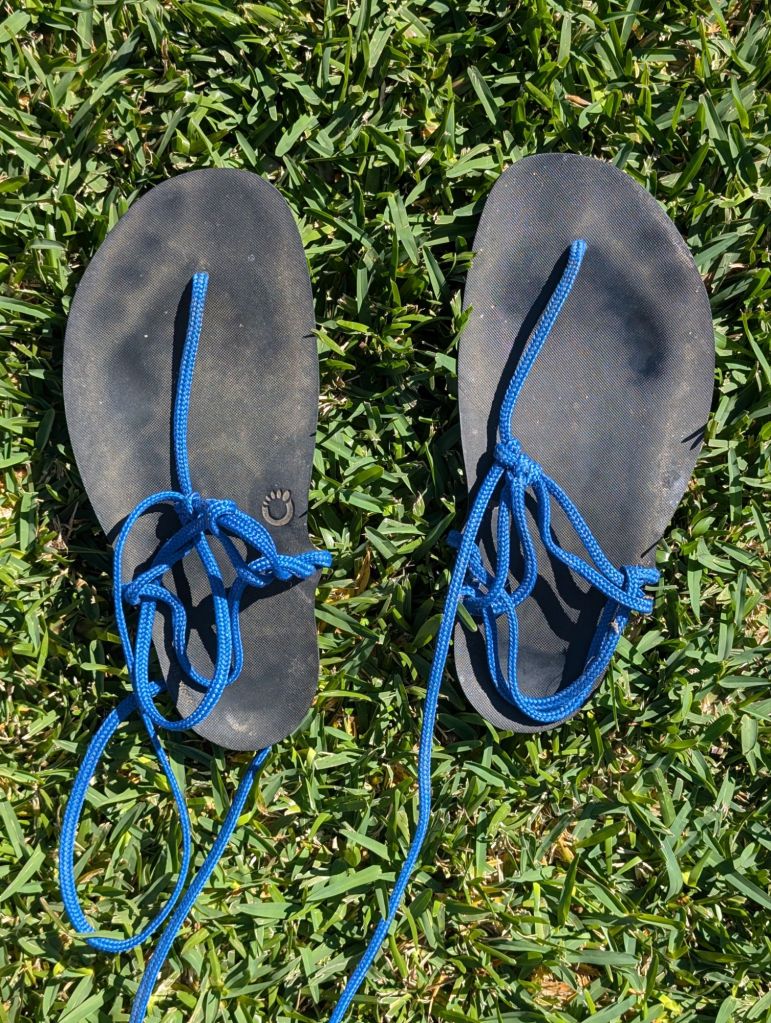
Barefoot/minimalist training is something I used to incorporate regularly into my training. A few years ago, during the “barefoot running boom” I would regularly run up to 20 km in these barefoot sandals.
and I had a lot of fun punching out the holes for the laces and learning to tie the required knots.
I’ll be reintroducing semi-barefoot running into my training over the coming weeks with the goal of building to about 15-20km twice a week in a slightly updated version of these sandals.
I am curious to find out:
How much barefoot running I can handle initially,
If any weaknesses in my form show up
If I notice any improvements in strength and speed.
I’ll try to post regular updates about my progress.
2.Half-fill a microwave-safe cup with water and place in the microwave next to the heat pack.
3.Hit start and heat for 1-2 minutes.
Adding the water to the process adds some moisture to the heat pack. Moist heat has been shown to be more effective than dry heat at penetrating muscles.
The moisture from the water also reduces the likelihood of burning the bag (you should still never heat for more than 1-2 minutes at a time).
Following a massage, and especially following dry needling, your therapist will often recommend applying a heat pack at home for 10 to 20 minutes a day for 2-3 days.
This helps relax the muscle, reduces pain, and increases blood and lymph flow, all of which improve the body’s ability to heal.
Dry needling is a technique sometimes used in conjunction with massage or physiotherapy (among other modalities) to create change within the muscular and myofascial systems.
It differs from acupuncture in that dry needling only aims to treat muscular and myofascial issues, with treatment rationales primarily based on Western understanding of physiology.
Dry needling is carried out by inserting acupuncture-type needles into the tissue to reduce trigger points (knots) by causing a twitch response, to create stretch within the surrounding fascia and to encourage inflammation and healing.
The ‘Dry’ in dry needling comes from the type of needles used; they are not syringe needles as nothing is injected into the body during dry needling.
The needles are very thin, usually around 0.25mm in diameter, and vary in length depending on the depth of the tissue being treated.
I offer dry needling as part of my remedial massage treatments if I think it might increase the efficiency and effectiveness of the treatment. Using needles can make it possible to treat more than one area of the body at the same time and can make it easier and quicker to treat the deeper muscles.
It is always up to the person being treated to decide if they would like to have dry needling during their massage sessions or not. Remedial massage therapists in Australia are required by our associations to hold a minimum of a Diploma of Remedial massage, complete additional, approved, training in dry needling and hold appropriate insurance.
Organisers of endurance events introducing amateur categories that restrict the number of hours athletes can train each week in order to compete in that category.
For example a half marathon might have categories for athletes training under or over 7hrs/wk, or an Ironman distance triathlon might have a 15hr and under /wk category. These categories could then be divided into current age groups. E.g women 30-34 training under 7hrs/ week.
Why I’d like to see this
It would be interesting
Restricting training volume would encourage athletes to experiment with other variables such as strength and technique training.
It could help reduce athlete stress, injuries andincrease long-term participation.
A stress reducing vista
It would mean less amateur athletes trying to cram in 20+hrs of training around full-time work and family commitments.
Problems?
I have no idea how this could be monitored. An honesty system perhaps? Strava tracking?
Feel free to comment if you have any thoughts or suggestions.
Has anyone tried training less than the maximum amount you could cram into a week and what was your experience?
Why Should I Schedule a Follow Up Massage Treatment?
When you have a massage treatment your therapist will often suggest a follow up treatment within about 10 days of the initial consultation. What is the purpose of a follow up massage and why should you bother going if your issue seems to have been ‘fixed’ after the 1st treatment?
We want to Know How You’ve Responded
The number one reason your therapist likes to follow up is because we want to know how you’ve responded to the treatment. We want to be sure that what we’ve done has had the desired effect and that there is no worsening of symptoms.
A time frame of around 4-10 days lets the body adjust enough after the treatment to give us an idea of what’s been achieved and where we need to go next. Sometimes this means more massage, a home exercise program or other intervention or perhaps referral on to a physiotherapist or exercise physiologist if appropriate.
Change takes Time It can take more than one treatment for the body to relearn appropriate movement patterns. A follow-up massage aims to reinforce changes made in the initial treatment. For example, if someone has become used to sitting with a slouched posture, they might find themselves sitting straighter in the couple of days following the initial massage but gradually revert to a slouched position over the next week or so. In this case, the follow-up massage acts as a reminder to the body that it is still capable of straitening up. It is also a good time for your therapist to go through some exercises or behaviour modifications to help with this relearning of movement patterns.
Why Should I Follow Up if I Feel better? Following up with your therapist when you feel better is a great opportunity to work on other areas of the body that may have contributed to the initial problem. For example, if someone presents with neck pain in the initial session and we find at the follow-up that their pain has subsided, then we might use the follow-up to work on shoulder and back muscles as restrictions in these areas can lead to overworking of the neck muscles. A follow-up massage can help ensure you reach your treatment goals sooner



 Body of Work